Extreme Sudoku
Play an extreme sudoku on screen, or print a set with answers. Every puzzle has exactly one solution.
Recent
Your last 10 settings, saved only in this browser. Nothing is uploaded.
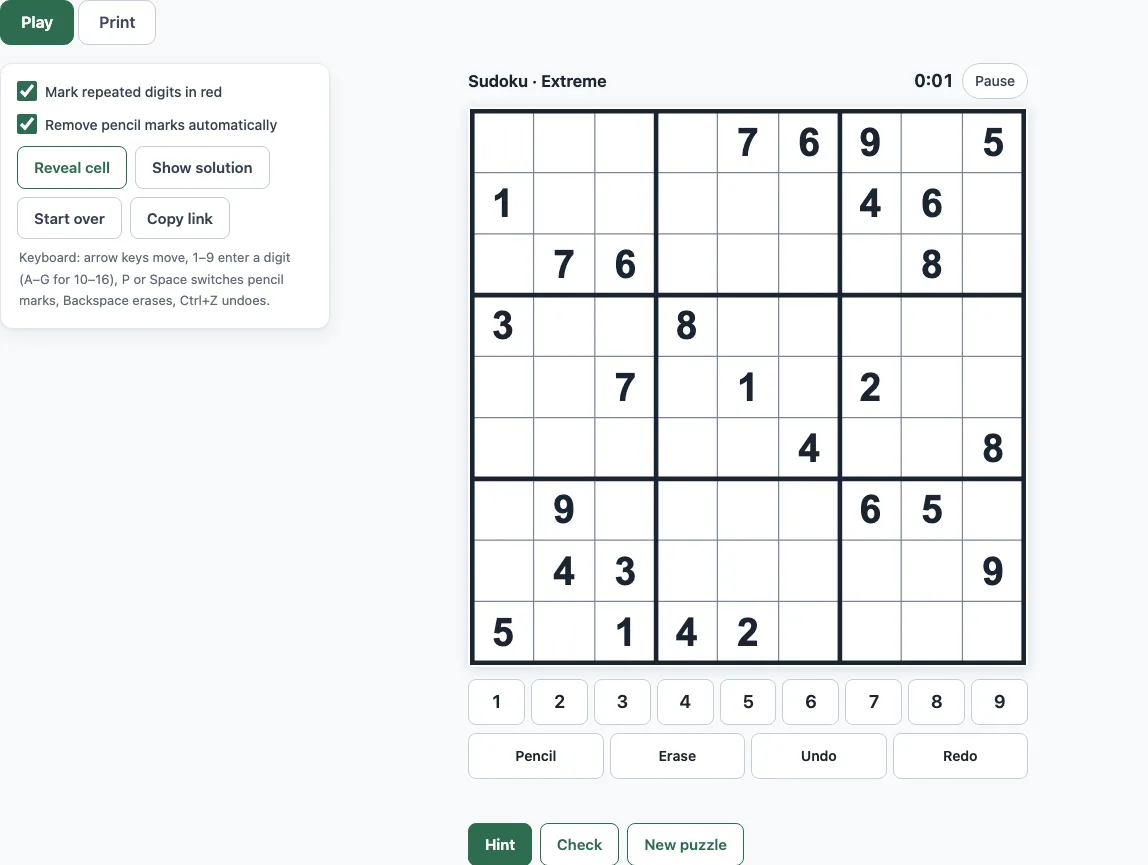
How to use the Extreme Sudoku
Open the page. The puzzle loads on the Play tab.
Click or tap an empty cell. You can also move with the arrow keys.
Click a number on the number pad, or type the digit, to place it.
Use the pencil button, or press P or Space, to switch to pencil mode. Digits you enter then appear as small notes in the cell, which is how you record candidates.
Press Hint when you are stuck. It names the technique for the next step, highlights the cells and explains it in one sentence. If one of your digits is wrong, it tells you to fix that first.
Press Check to mark wrong cells in red and see how many empty cells are left.
Press Ctrl/Cmd+Z to undo a move. Press Ctrl/Cmd+Y to redo. Undo makes it safe to test a digit and back out if it fails.
For a paper copy, open the Print tab. There is no difficulty menu, because every puzzle is Extreme: choose Puzzles per page, Number of pages and Paper size, then press Print / Save as PDF.
Turn on “Mark repeated digits in red” to spot clashes early. With “Remove pencil marks automatically” on, placing a digit deletes that digit’s notes from the cells it sees. Backspace erases a digit, and Pause stops the timer.
What makes a sudoku extreme, and how is it different from hard?
An extreme sudoku is a puzzle with exactly one solution that this site’s step-by-step logic solver cannot finish. A hard puzzle can be finished by the same solver, but it needs at least one of its strongest techniques: triples, X-Wing, Y-Wing, Swordfish or XYZ-Wing.
The solver knows 12 techniques, from easiest to hardest: Naked Single, Hidden Single, Locked Candidates (Pointing), Locked Candidates (Claiming), Naked Pair, Hidden Pair, Naked Triple, Hidden Triple, X-Wing, Y-Wing, Swordfish and XYZ-Wing. An extreme puzzle is one where those techniques stop with cells still empty. Solving it therefore needs longer chains, forcing chains, or trial and error.
Clue count does not separate the two levels. Across 200 extreme puzzles from the site’s generator, clues ranged from 24 to 32 (average 27.2), and hard puzzles also have 24 to 32. When the 12 techniques stop, about 35 of the roughly 54 empty cells remain empty on average, though this varies from 0 to 55.
How do I solve extreme sudoku?
Start with the methods that always apply, then move to chains and trials when they run out.
- Fill every Naked Single and Hidden Single.
- Write candidates in every empty cell.
- Use pairs, triples and wing patterns to remove candidates.
- When nothing else works, pick a cell with only two candidates.
- Place one candidate and follow the consequences. If it leads to a repeated digit or to a cell with no candidates left, the other digit is correct.
What comes after the 12 techniques?
Solvers and sudoku books name several methods beyond the list above. This page’s Hint does not teach them, so you will use pencil marks and undo instead.
- An XY-Chain is a chain of cells that each have exactly two candidates, where neighbours in the chain share a digit. If the first and last cells of the chain both have the same digit as a candidate, one of the two ends must hold that digit, so any cell that sees both ends cannot hold it.
- Colouring follows one digit at a time. Where a digit can go in only two cells of a row, column or box, one of them must be right, so you can mark the cells in two alternating colours; if two cells of the same colour see each other, that colour is false.
- A forcing chain starts from a cell with two candidates and follows what each choice makes certain. If both choices end up forcing the same digit in a distant cell, that digit goes there.
- Nishio is the simplest form of trial and error: assume one candidate, follow the consequences, and remove the candidate if it ends in a repeated digit or an empty cell.
You can solve any extreme puzzle from this page with candidates and careful trials alone, because each puzzle has exactly one solution.
Do extreme sudoku need guessing?
Often you must try a digit, but this is a supposition rather than a blind guess. You place a candidate, follow where it leads, and a clash shows whether it was wrong. Since the puzzle has exactly one solution, the contradiction tells you which digit belongs in the cell.
Are evil, diabolical and impossible sudoku the same as extreme?
Not on this site. Evil, diabolical, impossible and very hard are informal labels, not levels defined here. On this page, Extreme means only the definition above. The word “impossible” does not fit: every extreme puzzle has exactly one solution, so it can be solved. It is just beyond the 12 techniques.
Frequently asked questions
Does it work on a phone or tablet?
Yes. The page fits a phone screen: the board scales to the screen width and the number pad has large buttons, so you can tap a cell and then a number. The keyboard shortcuts (arrow keys, digits, Backspace and the Ctrl/Cmd keys) only apply when you use a keyboard.
Can I print extreme sudoku with answers?
Yes. On the Print tab there is no difficulty menu, because every puzzle is Extreme. Choose puzzles per page (1, 2, 4 or 6), the number of pages (1 to 20), and US Letter or A4. “Add answer pages at the end” is on by default. Preview page 1, then choose “Save as PDF” in the print dialog to get a file.
Can I print the same set again later?
Yes. Each printed set has a seed, shown in the footer and in the Seed field under “Repeat or share this set”. The same seed with the same settings produces the same puzzles.
Will my progress be kept if I reload or leave?
Progress is saved in your browser on this device, so a reload continues the same puzzle. To open the same puzzle on another device, use Copy link.
Does Check show me the answer?
No. Check marks wrong cells in red and says how many cells are left, but it does not fill in digits. Reveal cell fills the selected empty cell with the correct digit, and Show solution fills the whole grid.
What if no technique applies and I am stuck?
Hint says “No simple technique applies here” and fills in one correct digit for you. Use that digit to look for the next step.
Does the timer run when I switch tabs?
No. The timer stops while the browser tab is hidden or when you press Pause, and it runs while you play.
Related tools
- Hard sudoku: Use it when you want a puzzle one level below extreme, solvable with the strongest techniques.
- Medium sudoku: Use it when you are building up to harder grids.
- How to play sudoku: Read it to learn the rules and basic solving methods.
- Sudoku solver: Enter a puzzle from a newspaper or book to get the next logical step.
- Daily sudoku: Play a new puzzle each day.
- Killer sudoku: Try a variant that adds cage sums to the classic rules.
- Sudoku generator: Make custom puzzles to adjust the number of clues and layout.
- Printable sudoku: Print sets of puzzles for pencil and paper play.