Sudoku Hidden Triples
See a hidden triple on a real puzzle, or paste your own and find it.
Recent
Your last 10 settings, saved only in this browser. Nothing is uploaded.
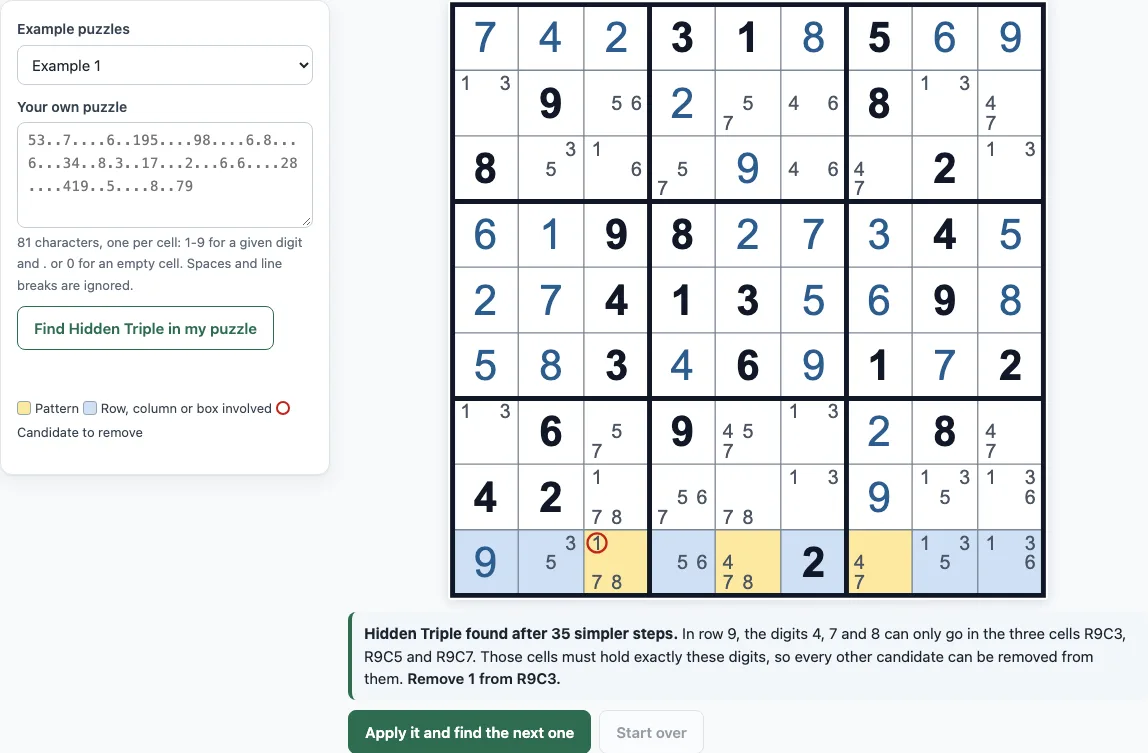
How to use the hidden triples tool
- Look at the board. The page opens on Example 1, which already shows a hidden triple.
- Read the message under the board. It names the simpler steps used first, then the exact cells and digits, then the candidates to remove.
- Use the colours to follow the pattern. Yellow cells are the pattern, blue cells are the row, column or box involved, and red circles mark the candidates that can be removed.
- Open the menu “Example puzzles” to choose Example 2, 3 or 4. Each is a different real puzzle, and choosing one starts the search again.
- To check your own puzzle, paste or type 81 characters into the input box. Use the digits 1 to 9 for given numbers and a dot or 0 for an empty cell. Spaces and line breaks are ignored, so you can paste a newspaper puzzle.
- Press “Find Hidden Triple in my puzzle”.
- If the text is wrong, a red message explains why, for example a wrong number of cells or two equal digits in one row, column or box.
- Press “Apply it and find the next one” to remove the red candidates, solve on with the easier techniques, and show the next place where a hidden triple works.
- Press “Start over” to go back to the first hidden triple in the puzzle.
If the tool reports that no further pattern exists, the message also says whether the puzzle is now solved.
What is a hidden triple in sudoku?
A hidden triple is a set of three digits that can go in only three cells of one row, column or box. Those three cells must hold exactly those three digits, so any other candidates in those cells can be removed. In Example 1 on this page, after 35 simpler steps, the digits 4, 7 and 8 in row 9 fit only in R9C3, R9C5 and R9C7. The 1 can therefore be removed from R9C3.
How do you find hidden triples?
Pick one row, column or box. For each digit from 1 to 9, list the cells where it can still go. Digits that fit in only two or three cells are the ones to watch. If three digits together use only three cells, you have a hidden triple. Example 2 is a column case: the digits 1, 4 and 5 fit only in R3C5, R7C5 and R9C5, so 3 and 9 are removed from R7C5 and 9 from R9C5. The method is easy to miss, which is why it is usually found only after the simpler techniques have been used.
What is the difference between a hidden triple and a naked triple?
A naked triple is three cells whose candidates together contain only three digits. Those digits can then be removed from the other cells of the unit. A hidden triple works the other way round: three digits are confined to three cells, and the other candidates are removed from those cells. Hidden triples are rarer and harder to see, because the digits are spread across more cells before the pattern becomes clear.
Does every cell of a hidden triple contain all three digits?
No. Each of the three cells must contain at least one of the three digits among its candidates, but the cells do not all need all three. In the examples on this page, one cell holds only two of the three digits. The rule still holds, because the three digits must occupy the three cells between them.
How often does a hidden triple appear?
On the site’s own puzzle generator, over 1,500 random single-solution puzzles with 22 to 27 clues, a hidden triple was the next move at some point in the easiest-first solve in 1.0 % of puzzles. The puzzles were not graded by difficulty. Hidden pairs appeared far more often, in 11.7 % of puzzles. Hidden triples belong mainly to hard puzzles.
Frequently asked questions
Can a hidden triple be found in a box or a column?
Yes. The rule applies to any row, column or box, so the same reasoning works in all three. The tool shows the unit it uses with blue cells.
Does the tool place any digits for me?
No. Pattern techniques only remove candidates. A digit is placed only when a cell is left with a single candidate.
Is a removal from a hidden triple always correct?
Yes, when the puzzle has a valid solution. The removal follows from the sudoku rules, and nothing is guessed. The tool checked its examples against a brute-force solver, and no removed candidate was a solution digit.
What does the tool say if my puzzle has no hidden triple?
It reports that the pattern does not turn up. The message says either that the puzzle is solved with other techniques, or that the 12 techniques cannot finish it, which means a harder technique or a guess is needed.
Do “sudoku triples” and “hidden triples” mean the same thing?
No. “Sudoku triples” covers both naked triples and hidden triples. This page covers only the hidden kind. Naked triples have their own tool on this site.
Related tools
- How to play sudoku: read this if you are new to sudoku and want the basic rules and strategies before using advanced techniques.
- Sudoku solver: use this when you want the full solution to a puzzle rather than a single technique.
- Medium sudoku: try these puzzles if you want practice before the harder techniques appear.
- Hard sudoku: use these puzzles to practise techniques like hidden triples, which appear mostly in hard puzzles.
- Extreme sudoku: choose these when you have mastered hard puzzles and want the most challenging grids.
- Sudoku generator: create new puzzles to test a technique on fresh grids.
- Daily sudoku: solve a new puzzle each day for regular practice.