Sudoku Swordfish
See a swordfish on a real puzzle, or paste your own and find it.
Recent
Your last 10 settings, saved only in this browser. Nothing is uploaded.
This tool finds the sudoku swordfish pattern in a puzzle and shows exactly which candidates it lets you remove. Swordfish is the three-line version of the X-Wing: one digit, three rows and three columns. It runs in your browser, is free, needs no sign-up and nothing to install, and does not upload your puzzle.
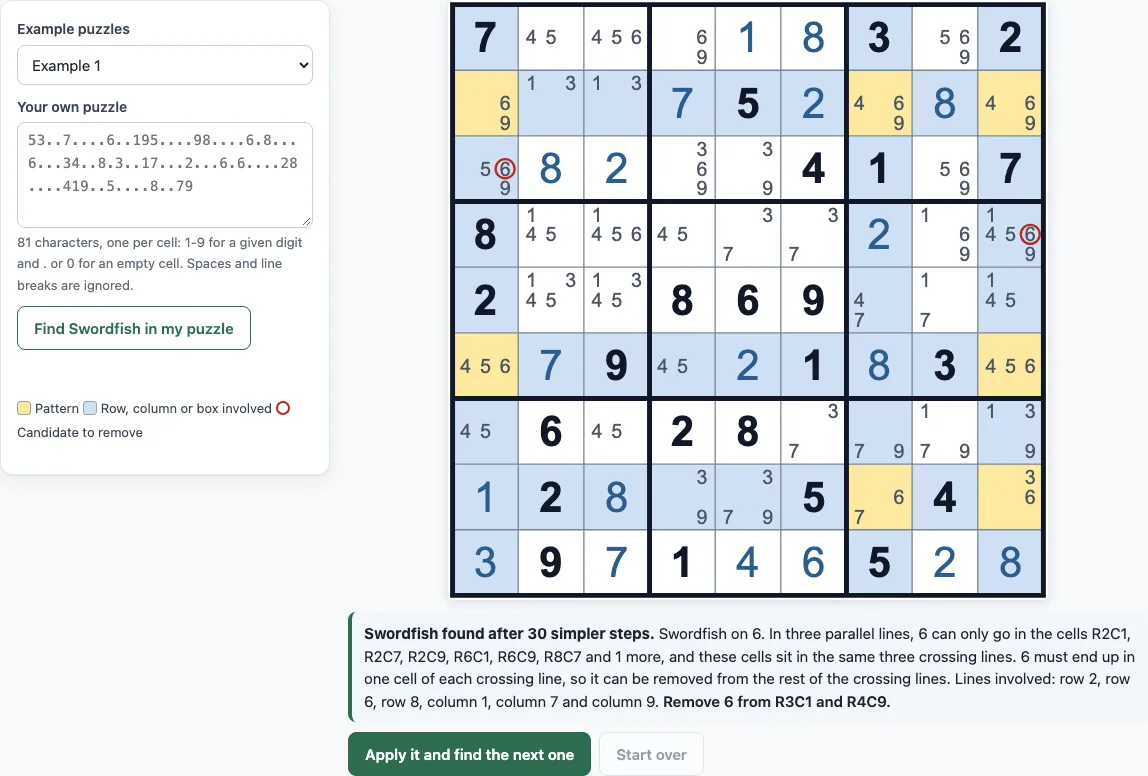
The page opens on Example 1, a real puzzle where a swordfish is the next move after 30 simpler steps. The board marks the pattern and the cells involved, and a message under the board names the digit and the candidates to remove. You can also paste your own puzzle and check whether this technique appears in it.
How to use the Sudoku Swordfish Finder
- The page opens on Example 1, and the swordfish is already shown on the board. Read the message under the board first.
- Look at the colours. Yellow cells are the pattern, blue cells are the rows, columns or boxes involved, and red circles are the candidates that can be removed. The small digits in empty cells are the pencil marks.
- To try another puzzle, open the menu “Example puzzles” and choose Example 2, 3 or 4. Choosing one starts the search again.
- Press “Apply it and find the next one” to remove the red candidates, solve on with the easier techniques, and show the next place a swordfish works.
- Press “Start over” to go back to the first swordfish in the puzzle.
- To check your own puzzle, clear the text box and paste or type 81 characters, one per cell. Use the digits 1 to 9 for given digits and a dot or 0 for an empty cell. Spaces and line breaks are ignored.
- Press “Find Swordfish in my puzzle”. Red messages point to a problem with the text, such as the wrong length, a character that is not a digit or empty cell, a repeated digit in a row, column or box, or a puzzle with no solution.
A newspaper puzzle can be copied into the box the same way. If your puzzle has more than one solution, the tool adds a note, and the moves it shows are still valid logic.
What is a swordfish in sudoku?
A swordfish is a solving pattern that works on one digit across three rows and three columns. It removes candidates for that digit from cells that cannot hold it, so one digit is ruled out in places where it would otherwise have been possible. It is one of the pattern techniques, the same family as X-Wing.
How do you find a swordfish in sudoku?
Pick one digit, such as 6, and write down where it can still go in every empty cell. Then:
- In each row, count the cells where the digit can go. Keep the rows with two or three such cells.
- Look for three of those rows whose candidate cells all lie in the same three columns. A row with only two cells can take part as long as both of its columns are among the three.
- Each of the three rows must hold the digit in one of those columns, and each column can hold it only once. So the digit is fixed to those three columns in those three rows.
- Remove the digit from every other cell in those three columns.
In Example 1, the digit 6 can go in row 2 only in columns 1, 7 and 9, in row 6 only in columns 1 and 9, and in row 8 only in columns 7 and 9. Those rows use only columns 1, 7 and 9, so the tool removes 6 from R3C1 and R4C9.
What is the difference between X-Wing and swordfish?
X-Wing uses two rows and two columns, while a swordfish uses three of each. The logic is the same: a digit is locked into a fixed set of lines, so it can be removed from the other cells of those lines. A four-line version is called jellyfish. The tool tries X-Wing before swordfish, which fits with X-Wing being the smaller pattern.
Does swordfish work on columns as well as rows?
Yes. The method works in both directions. You can look for three columns whose candidates for a digit sit in the same three rows, then remove that digit from the other cells of those rows. Example 2 on this page is a swordfish on the digit 8 built from columns. Columns 1, 5 and 7 hold the 8 only in rows 6, 7 and 8, so the tool removes 8 from R7C9 and R8C4.
Do I need swordfish to solve a sudoku?
Not usually. Easy and medium puzzles never need it, and it belongs to hard puzzles. Some hard puzzles can only be finished with it, and others need an even harder technique or a guess.
How often does a swordfish appear?
The site measured this on its own puzzle generator, using 1,500 random single-solution puzzles with 22 to 27 clues. In 1.1 % of them, a swordfish was the next move at some point of the easiest-first solve. For comparison, Hidden Pair was 11.7 %, Y-Wing 8.1 %, X-Wing 3.0 % and Naked Triple 2.5 %. The puzzles were not graded by difficulty.
Frequently asked questions
Does the tool place the digits for me?
No. A swordfish only removes candidates, and it never places a digit directly. A digit is placed later, once a cell has only one candidate left.
Are the removals always correct?
Yes, because each removal follows from the rules of sudoku, so nothing is guessed. The tool checked all its examples against a brute-force solver, and no removed candidate was the solution digit.
What if my puzzle shows no swordfish?
The message will say either that the puzzle is solved with other techniques, or that the 12 techniques on this site cannot finish it. In the second case, the puzzle needs a harder technique or a guess.
Can I check a puzzle that has more than one solution?
Yes. The tool accepts it and adds a note that the moves are still valid logic. Each removal it shows is still a correct deduction from the given digits.
How often does a swordfish appear?
It is rare. In 1,500 random single-solution puzzles made by this site, a swordfish was the next move at some point in only about 1 % of them, so it belongs to hard puzzles.
Sudoku swordfish explained: what does the pattern look like?
One digit sits in only two or three cells of each of three rows, and all those cells fall in the same three columns. The digit must then be in one cell of each of those columns, so it is removed from the other cells of those columns. The same works with rows and columns swapped.
Related tools
- How to play sudoku: Read this if you are new to sudoku and want the basic rules and first techniques.
- Hard sudoku: Use this to practise puzzles where techniques like swordfish are more likely to be needed.
- Sudoku solver: Use this when you want the full solution to a puzzle rather than one technique at a time.
- Extreme sudoku: Choose this for the most demanding puzzles, which often need several advanced patterns.
- Sudoku generator: Use this to create a new puzzle to test your skills on.
- Medium sudoku: Use this for puzzles at a middle level, where pairs and simple patterns usually do the work.
- Daily sudoku: Use this for a new puzzle each day.
- Printable sudoku: Use this when you want puzzles on paper.