Sudoku XY-Wing
See an XY-Wing on a real puzzle, or paste your own and find it.
Recent
Your last 10 settings, saved only in this browser. Nothing is uploaded.
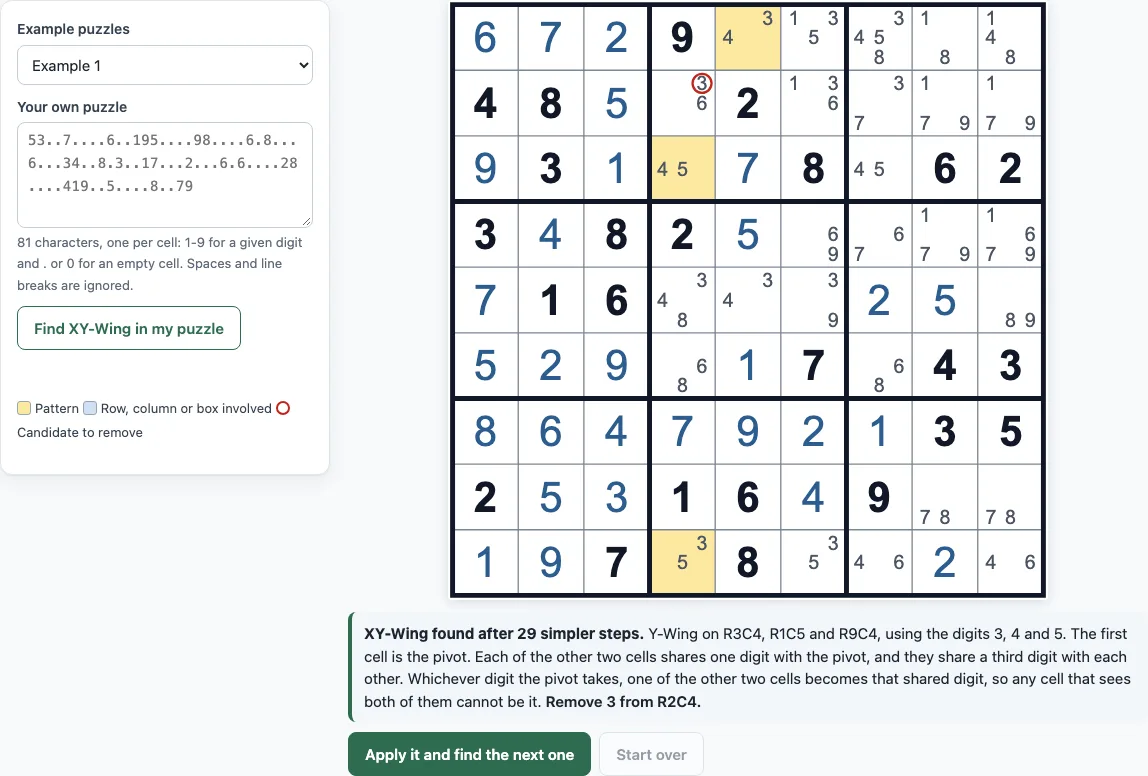
How to use the XY-Wing finder
- Open the page. It starts on Example 1 and shows the first XY-Wing it finds.
- Read the message under the board. It gives the number of simpler steps used first, then names the exact cells and digits, then says what to remove.
- Look at the colours. Yellow cells are the pattern, blue cells are the rows, columns or boxes involved, and red circles mark the candidates that can be removed.
- To try another real puzzle, open the menu ‘Example puzzles’ and choose Example 2, 3 or 4. Each one starts the search again.
- To check your own puzzle, paste or type 81 characters into ‘Your own puzzle’. Use the digits 1 to 9 for given digits and a dot or 0 for empty cells. Spaces and line breaks are ignored.
- Press ‘Find Y-Wing in my puzzle’. Problems are shown in red, such as the wrong length, a character that is not a digit or empty cell, two equal digits in one row, column or box, or no solution.
- Press ‘Apply it and find the next one’. The tool removes the red candidates, solves on with the easier techniques, and shows the next place the XY-Wing works.
- Press ‘Start over’ to go back to the first one.
What is an XY-Wing in sudoku?
An XY-Wing is a sudoku pattern made of three cells that each have exactly two candidates. It lets you remove one digit from any cell that sees two of those three cells. The three cells are a pivot with candidates X and Y, a wing with X and Z, and a second wing with Y and Z.
Two cells see each other if they share a row, column or box. Both wings must see the pivot. Whatever digit the pivot takes, one wing must become Z: if the pivot is X, the first wing cannot be X, so it is Z; if the pivot is Y, the second wing is Z. So any cell that sees both wings cannot be Z, and Z can be removed from it. The two wings do not need to see each other.
How do you find an XY-Wing?
Look for cells with exactly two candidates, then build the pattern around one of them. Pick a pivot and check whether two cells that see it fit the pattern.
- Choose a cell with exactly two candidates, X and Y, as the pivot.
- Find a cell that sees the pivot and has exactly two candidates: X and Z.
- Find a second cell that sees the pivot and has exactly two candidates: Y and Z.
- Check that both wings carry the same third digit, Z.
- Find every empty cell that sees both wings and contains Z. Remove Z from each one.
In Example 1, the pivot is R3C4 with candidates 4 and 5. One wing is R1C5 with candidates 3 and 4, and the other is R9C4 with candidates 3 and 5. The shared digit is 3. Since R2C4 sees both wings and has a 3 among its candidates, the 3 is removed from it, leaving 6.
Is an XY-Wing the same as a Y-Wing?
Yes. XY-Wing and Y-Wing are two names for the same pattern, so a search for “sudoku y wing” or “y-wing technique” describes the same idea. The site’s solver and its step messages use the name Y-Wing, so a message may read “Y-Wing on R3C4, R1C5 and R9C4”. This page uses XY-Wing in its headings.
What is the difference between XY-Wing and XYZ-Wing?
An XYZ-Wing has a pivot with three candidates, X, Y and Z, and two wings with X and Z, and Y and Z. The XY-Wing pivot has only two candidates. Because the pivot itself may be Z, Z can only be removed from cells that see all three cells, not just the two wings.
How often does an XY-Wing appear?
In a test on 1,500 random single-solution puzzles with 22 to 27 clues, 8.1 % of puzzles needed an XY-Wing as the next move at some point of the easiest-first solve. Only Hidden Pair (11.7 %) was more common among the techniques measured. The puzzles were not graded by difficulty. XY-Wings mostly belong to hard puzzles, and easy and medium puzzles rarely need one.
Frequently asked questions
Does the XY-Wing finder place digits for me?
No. The XY-Wing only removes candidates. A digit is placed once a cell has only one candidate left, which happens when the solver continues with the easier techniques.
Can I check a newspaper sudoku with this tool?
Yes. Copy the grid into the ‘Your own puzzle’ box as 81 characters, using digits for given numbers and a dot or 0 for empty cells. Then press ‘Find Y-Wing in my puzzle’.
What does it mean if the message says the puzzle is solved with other techniques?
Your puzzle never needs an XY-Wing, so the tool found another way to solve it. The XY-Wing may still appear earlier in the solve, but an easier move also works there.
Is a removal from an XY-Wing always correct?
Yes. The removal follows from the rules, so nothing is guessed. The tool checks its examples against a brute-force solver, and no removed candidate is the solution digit.
How common is an XY-Wing?
In 1,500 random single-solution puzzles made by this site, an XY-Wing (the site’s solver calls it a Y-Wing) was the next move at some point in about 8 % of them. It belongs to the Hard level here.
What is the difference between an XY-Wing and an XYZ-Wing?
An XYZ-Wing has a pivot with three candidates, X, Y and Z, and wings with XZ and YZ. Z is then removed only from cells that see all three cells, while an XY-Wing removes it from cells that see both wings.
Sudoku XY-Wing explained in one sentence?
Three cells with two candidates each, X and Y in the pivot, X and Z in one wing, Y and Z in the other, force one wing to be Z, so Z leaves every cell that sees both wings.
Related tools
- How to play sudoku: read this first if you are new to candidates and pencil marks.
- Medium sudoku: practise on puzzles that rarely need an XY-Wing.
- Hard sudoku: use this when you are ready for puzzles where XY-Wings appear.
- Extreme sudoku: try this for the hardest puzzles, which need advanced patterns.
- Sudoku solver: use this to get the full solution of a puzzle you are stuck on.
- Sudoku generator: create new puzzles to practise on.
- Daily sudoku: play a new puzzle each day.
- Printable sudoku: print puzzles to solve on paper.